
How Bench Warrants Work in Colleton County
A bench warrant is court process tied to a case or missed obligation. In South Carolina, the local public form is titled “Bench Warrant after Failure to Appear.” A missed date under a previously set bond is one documented trigger. Courts may also use warrant process for bond violations, contempt, or other noncompliance, depending on the order.
An unpaid fine does not automatically mean a warrant issued. Colleton’s official fine instructions describe payment methods but do not label an unpaid balance “capias pro fine.” Ask the issuing court whether the problem is a balance, an FTA, or an active bench warrant.
Colleton Traffic FTAs Start at Summary Court
Colleton traffic and summary cases are centralized at the Jessie D. Padgett Building. The Clerk of Court directs ticket and Traffic Court questions away from General Sessions records and to Summary Court. A missed municipal ticket date, however, belongs with the city court named on the citation. Start by matching the missed setting to the court that scheduled it.
Do not assume that every unpaid ticket became a warrant. Call the clerk and ask whether the court entered an FTA, issued a bench warrant, or simply shows an unpaid amount. Those are different case states and can call for different next steps.
Bench Warrant Issuance in Colleton County
The judge enters the order in the court connected to the case. The South Carolina SCCA523 form asks for the county, court, case number, missed appearance date, prior bond, and underlying matter. It commands an officer to take the named person into custody and includes an officer-return section. It is a blank statewide form, not a public Colleton warrant list.
After issuance, the court and serving agency have separate roles. Rule 30 assigns the Sheriff and other appropriate agencies continuing responsibility to make reasonable efforts to serve bench warrants and report on unserved process. The court decides whether to recall, reset, or change the order.
Colleton’s SCCA523 Form Shows the Trigger
The form’s fields connect the warrant to a missed date and a prior bond, then identify the court and case. Its service section records the officer’s name, date, and jail placement. The form directs that the person be brought before court within 24 hours. That instruction belongs to this specific bench-warrant form and should not be applied as a universal timing promise for every arrest.
The South Carolina court-forms page lists SCCA523. It gives no standard bond amount, public recall fee, or one-size-fits-all clearing process.
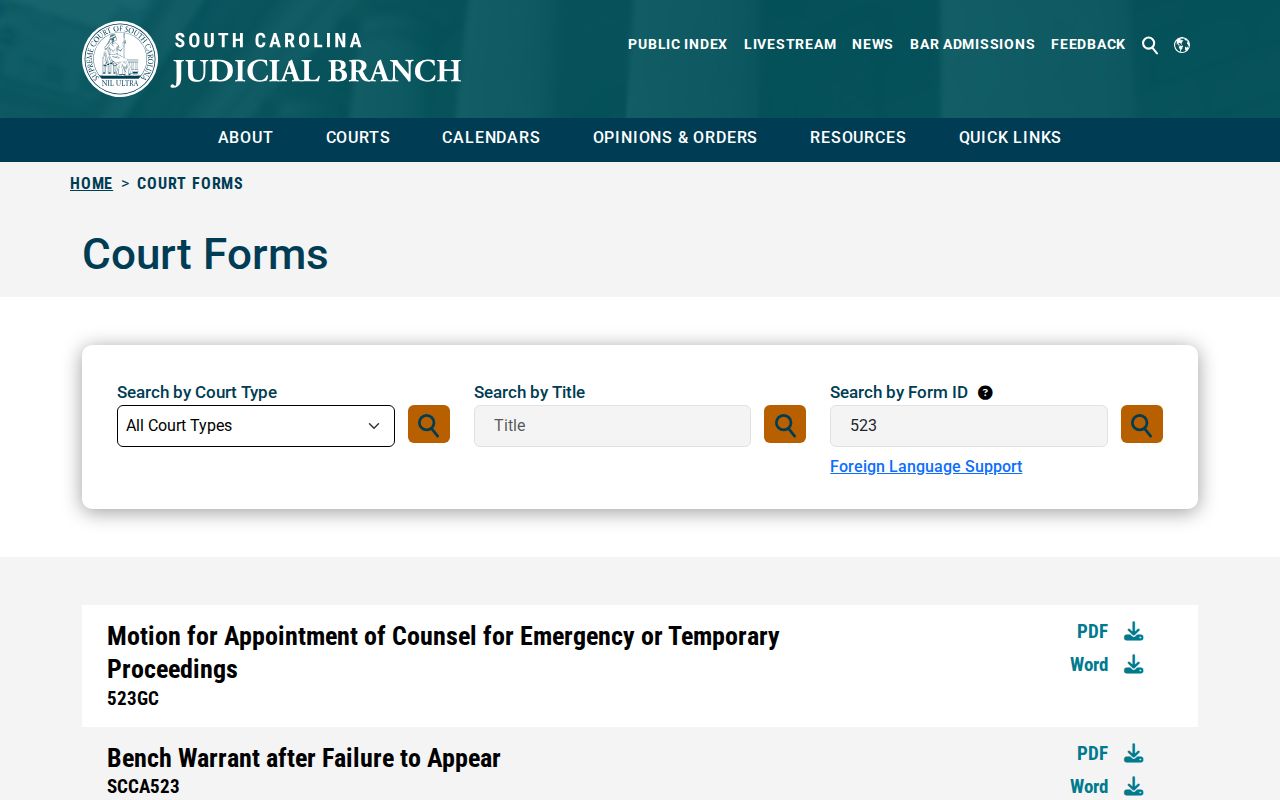
The official form index identifies the process by its full title rather than a local capias label.
How Bench and Arrest Warrants Differ
A bench warrant follows a court event such as a missed appearance; an arrest warrant is based on probable cause for an alleged offense. Both can lead to custody, but the issuing court and reason control the way forward. The Sheriff may serve either order, but does not decide whether the judge should withdraw it.
| Feature | Bench Warrant | Arrest Warrant |
|---|---|---|
| Trigger | Missed court date, bond violation, or court noncompliance | Officer-sought process based on probable cause |
| Issuer | Judge in the court handling the case | Magistrate or other authorized judge |
| Case link | Existing case or court obligation | Charge or investigation |
| Next step | Ask about recall, reset, appearance, or bond | Confirm the issuing court and counsel-led appearance route |
Rule 30 Keeps Colleton Service Moving
South Carolina Criminal Rule 30 directs the Sheriff and other appropriate agencies to keep making reasonable efforts to serve bench warrants and to report their status. A warrant that has not been served can remain in the court’s process even when there is no public online roster. Ask the Sheriff whether its office has the order, then ask the issuing clerk about the court’s current record.
The text of Rule 30 describes this continuing duty. It does not give the Sheriff authority to recall a judge’s warrant.
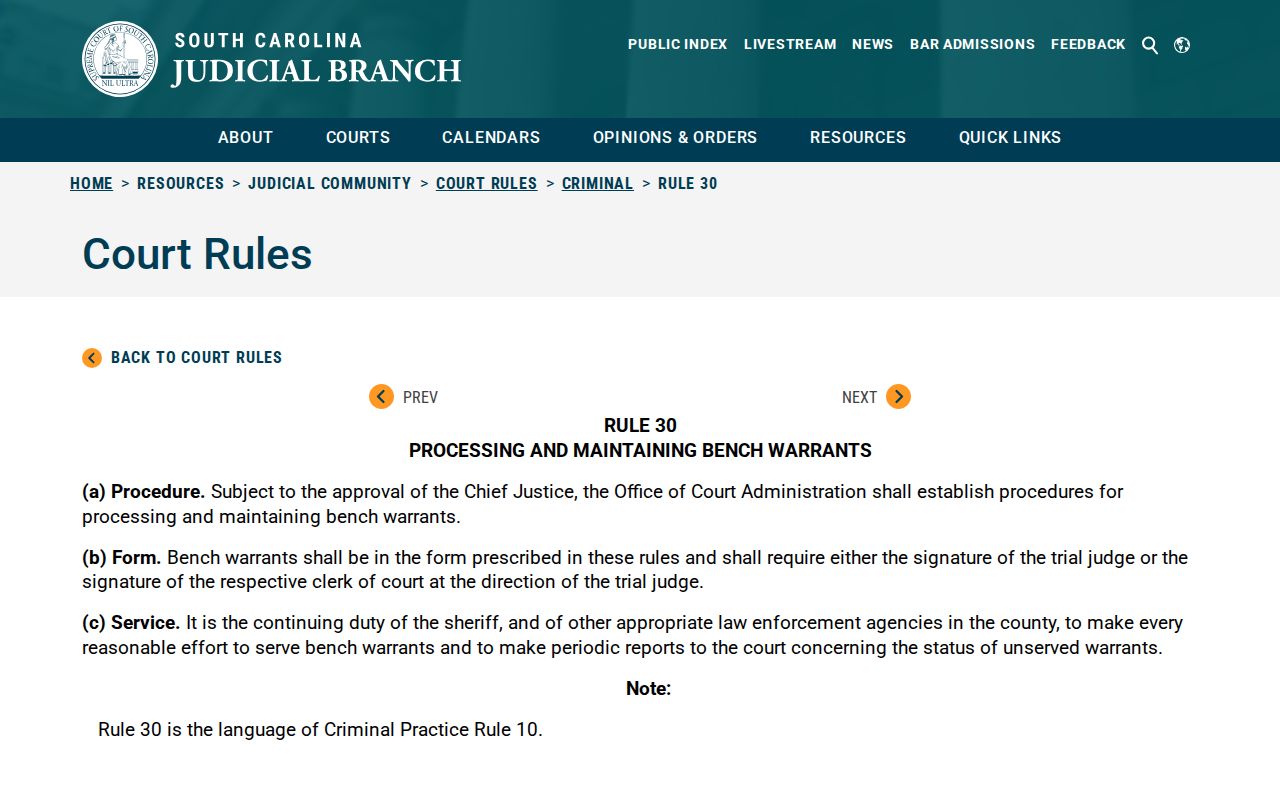
The court rule explains why a service question belongs with law enforcement while a recall request belongs with the court.
Clearing a Bench Warrant in Colleton County
Call the court that issued the order and the Sheriff’s warrant desk. Ask whether the judge will reset or recall the warrant, whether an appearance or surrender is required, and whether bond has been set. Colleton has no standard public recall form or fee schedule. If the matter is a felony or the bond conditions are unclear, speak with an attorney before making an appearance plan.
- Confirm the active status and issuing court with the Clerk or municipal / Magistrate clerk and the Sheriff’s warrant desk.
- Ask an attorney whether to request a recall, quash, new date, or planned surrender.
- Confirm where and when the judge requires an appearance, and ask about counsel, identification, and bond.
- Resolve the underlying court obligation, then request written proof that the warrant status changed.
Caution: Do not assume a missed date or unpaid balance has disappeared; confirm the court’s order before travel, payment, or surrender.
Colleton Recall Belongs to the Judge
The Sheriff’s Warrant Clerk can check service information and direct a caller to the issuing court, but the clerk cannot withdraw the judge’s order. A recall or quash is a court action. No general Colleton motion-to-recall form, filing fee, remote appearance rule, or walk-in docket was found in official sources.
“Recall” means the court withdraws the warrant. “Quash” means the court sets it aside. A reset may put the person back on a calendar without resolving the underlying charge or balance. Ask which action the court is considering and get the next date in writing.
- FTA
- Failure to appear at a required court date.
- Recall
- Court action withdrawing its warrant.
- Bond
- Release terms set by the court, not a countywide fixed amount.
No Colleton Capias-Pro-Fine Label Located
The official South Carolina form and the local sources reviewed use “bench warrant” and “failure to appear.” They do not identify “capias pro fine” as the Colleton public label for an unpaid fine. That distinction matters because a balance, tax-refund setoff, and warrant are not the same event.
Walterboro warns that unpaid fines and costs may be sent through the Setoff Debt Collection Act, which can affect a state tax refund. Ask the court whether a separate warrant exists and what action will resolve it.
Colleton County Courts That Issue Bench Warrants
Read the ticket or case paperwork for the court name. These offices keep different case types, and the correct court controls the recall request.
| Court | Common Colleton matter | Contact |
|---|---|---|
| General Sessions | Felony case or circuit-level appearance | Clerk, (843) 549-5791 |
| Magistrate / Summary Court | Traffic, misdemeanor, bond, preliminary hearing | (843) 549-1122; traffic (843) 549-1140 |
| Walterboro Municipal | City traffic, ordinance, adopted state misdemeanor | (843) 782-1057 |
| Cottageville Municipal | Town traffic, ordinance, qualifying state offense | (843) 835-8655 |
| Edisto Beach Municipal | Town ordinance and qualifying offense | (843) 869-2505 |
| Family Court | Child-support or contempt process | Family staff, (843) 549-2870 |
For a fuller county contact route, use the Colleton County warrant overview and match the office to the type of case.